Tuesday, May 26, 2015
Google Maps SDK for iOS now supports Apple A7s 64 bit architecture

If youre an iOS developer who uses Google Maps in your apps, youre gonna like the latest Google Maps SDK for iOS.
Google Maps SDK for iOS version 1.6 adds full support for Apples 64-bit A7 processor. This means Googles Maps can now take full advantage of the power of Apples latest chip. Another nice new feature of the SDK is support for marker opacity, which allows developers to set the transparency of map markers that are displayed. Heres the full release notes:
- The Google Maps SDK for iOS now supports 64-bit architectures. Both 32- and 64-bit binaries are built into the single GoogleMaps framework. The correct binary will be selected by Xcode based on your build settings. For instructions on building 64-bit applications, please refer to Apples 64-bit transition guide. (Issue 5806)
- Changed some instances of CGFloat to either a float or double where it was more appropriate.
- Added the ability to restrict min and max zoom on GMSMapView. (Issue 5882)
- Added opacity on GMSTileLayer and GMSMarker.
- Core Animation on GMSMapView now requires model values to be set
Google Maps SDK for iOS version 1.6 can be downloaded here.
Data source: via TUAW (By Michael Grothaus)

Monday, May 25, 2015
Apple Buys Topsy For Price Reportedly North Of 200M Could Use Social Signals To Bolster Siri App Store Relevance

Topsy is one of several firms that have been focused on gathering and parsing data from Twitters platform. It allows customers to tap into a store of over 425 billion tweets from 2006 onwards to sniff out trends. Topsy competitors in the Twitter data reselling game include DataSift and Gnip, but its user-facing tools, including a topic and trends search engine, have made it one of the more popular options for those looking to make sense of the stuff people are tweeting about.
Given that Apple is a Twitter partner already, and hosts login and posting features for the social network on its iOS and OS X platforms, this seems like a confusing deal if all that its after is the Twitter data firehose. It seems more likely that Topsy has technology or engineers (read: acqui-hire) that can parse trends in a way that Apple wants to incorporate into one of its products.
If I had to hazard a guess, this might be related to Apple building out the relevancy engine of its App and iTunes Stores. Adding social signals to the search algorithms of its stores could help to improve the relevance of search results and help Apple surface apps that are hotter and more interesting to users. Tracking app trends across social networks would allow them to fine tune categories and collections of apps, and surface apps that are gaining steam more quickly.
Pulling the thread out a bit further, its possible that Apple could even use the data from your Twitter feeds to recommend apps on a more personal basis, rather than ‘generically to everyone. Apple has done little of this kind of personalized recommendation work to this point, but theres always a first time for everything.
The WSJ article points to iTunes Radio ads and the iAd platform as possible beneficiaries of the Topsy engine, too. Apple could theoretically use social data to help advertisers display ads to more relevant viewers. This would boost revenue and relevance across Apples ad platforms, which havent been incredibly robust so far.
Apple purchased the app search company Chomp last year, but ended up using mostly its ‘card-like interface, not what some viewed to be its superior discovery model. Unfortunately, the acquisition did not lead to a massive improvement in app store search results. Apple has recently been tweaking results to better correct for misspellings and mis-typing when searching the store.
There is also a slim possibility that Apple may want to use Topsys stored trends data and firehose access to improve Siri search. It could provide Siri with a reliable way to present people with trending topics and search results according to Twitter when queried.
Topsy has also filed for over a dozen patents related to social networks. These includesystems and methods for prediction-based crawling of social media network and systems and methods for customized filtering and analysis of social media content collected over social networks.
As one of only a handful of companies with Twitter firehose access, and one of Twitters first Certified Product partners, Topsys purchase will change the market for those left behind.
Whatever use Topsys team or product is put to, its strengths came in real-time parsing of enormous data sets, so it would be something that was time-sensitive or able to be continuously affected by a feed of information. It shows that Apple has a growing interest in the data flowing through networks like Twitter, which is a refreshing notion. The company has not typically been bullish in this arena previously. Apple confirmed the purchase with the WSJ.
Sunday, May 24, 2015
Apple patents Lytro like refocusable camera suitable for iPhone

Apples U.S. Patent No. 8,593,564 for a "Digital camera including refocusable imaging mode adaptor," describes a method in which a user can take a picture at a certain resolution and refocus the resulting image after the fact. Also noted in the patent is the inclusion of such a system in portable devices, like an iPhone.

Source: USPTO
In fact, Apples patent cites Ngs invention as prior art, but notes improvements can be made in regard to picture quality and resolution.

Lytro light-field camera. | Source: Lytro
Light field technology uses so-called microlenses disposed in front of a CMOS or CCD sensor, which together form a "ray sensor" capable of capturing intensity of light as a function of position and angle. The microlens array directs light in a specific and predictable manner based on the lens aperture. In the case of Apples patent, each microlens corresponds to a fixed set of imaging pixels. After the light information has been recorded, software can be used to focus and refocus the corresponding image.
Unlike Lytro, Apples design employs a movable adaptor situated between the lens element and the imaging sensor. The adaptor holds the microlens array, meaning the camera can operate in two separate modes: high-resolution non-refocusable and low-resolution refocuasable. Lytros microlens component can also be moved closer and farther from the sensor, but cannot be completely removed from the light path.
Apples patent describes the adaptor as a switchable optical module mounted to a bracket, on which a glass plate is also positioned for normal high-resolution photos.

Low-resolution refocusable mode with microlens array active.
When in low-resolution refocusing mode, as seen above, the optical module is positioned between the lens and the sensor, thus creating a ray sensor. The patent notes the sensor records light data from the microlens (positioning) and angle of incidence (direction). Spatial resolution is limited to that of the microlens array.
In high-resolution non-refocusing mode, seen below, the switchable optical module moves to a different position in which the glass plate is situated between the lens and imaging sensor. Light is redirected by the glass pane onto the sensor to create an image of the scene as would a normal camera. The glass has a thickness and refraction index that compensates for the focal plane adjustment made to accommodate the microlens array. This mode allows for the sensors full resolution to be used.

High-resolution non-refocusable mode with microlens array inactive.
In some embodiments, the hardware includes smartphone-like features, like the ability to place phone calls and connect to a wireless network. Other forms of the patent include a system that can be used as an add-on accessory for any existing camera, an interesting thought given the standalone Lytro starts at $299.
It is unknown if Apple will employ the technology in a later iPhone model, though the solution would be a welcome addition for many users who have trouble focusing on small screens. Perhaps most interesting is the possibility of a light-field video camera. Refocusable movies would be a great addition to the iPhone, which lacks tactile controls for focusing on the fly.
Apples plenoptic adaptor patent was first filed for in 2011 and credits John Norvold Border and Richard D. Young as its inventors.
Data source: via AppleInsider (By Mikey Campbell)
Saturday, May 23, 2015
iPhone 5s and iPhone 5c Tempting Fewer Early Upgraders

Apples iPhone 5s and iPhone 5c were most popular with previous iPhone owners upgrading from older iPhones, according to new data gathered by Consumer Intelligence Research Partners.
Approximately 65 percent of total iPhone 5s/5c buyers in the United States previously owned an iPhone, compared to 55 percent of iPhone 5 purchasers a year ago. While 12 percent of consumers who purchased an iPhone 5 last year were upgrading from an iPhone 4s, just 6 percent of iPhone 5s/5c purchasers upgraded from an iPhone 5, with the rest of the former iPhone buyers coming from older models like the iPhone 4 and 4s or non-iPhone devices.
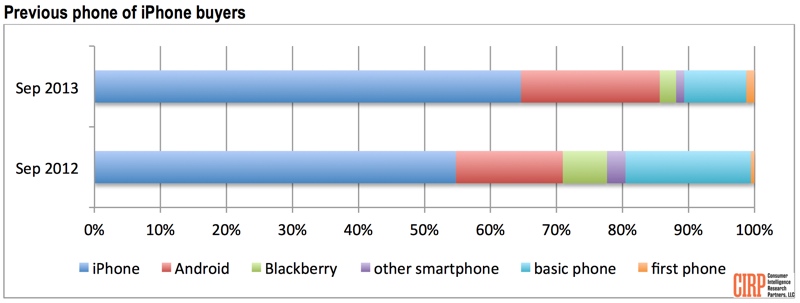
The lack of interest from iPhone 5 owners is likely due to the fact that the iPhone 5s and the iPhone 5c are somewhat minor updates that have not resulted in a change in form factor. The iPhone 5c in particular uses the same components found in the iPhone 5, and it is possible that continued iPhone 5s shortages have discouraged some iPhone 5 owners from upgrading to the latest model.
"We see a noticeable decrease in the number of iPhone buyers that seem to want the latest, most advanced phone," said Josh Lowitz, Partner and Co-Founder of CiRP. "For the iPhone 5S/5C, 6% of buyers upgraded from the year- old iPhone 5. In contrast, at the launch of the iPhone 5 in September 2012, 12% of customers upgraded from the year-old iPhone 4S." Within the two-thirds of iPhone buyers that upgraded from an existing iPhone in September and October 2013, many fewer upgraded from the year-old iPhone 5, relative to the 55% of iPhone 5 buyers in September and October 2012 that upgraded from the year-old iPhone 4S.
The iPhone 5s and 5c also saw higher adoption numbers from former Android users, though adoption by former basic phone users and BlackBerry users declined, likely due to a loss of overall market share in those groups.
CIRPs data is based on a survey of 400 U.S. iPhone buyers that activated a phone after the September 20 launch of the iPhone 5s and 5c.
CIRPs data is based on a survey of 400 U.S. iPhone buyers that activated a phone after the September 20 launch of the iPhone 5s and 5c.
Data source: via MacRumors (by Juli Clover)
Friday, May 22, 2015
Apples iPhone 5s tops sales charts at big 4 US carriers iPhone 5c close behind

Apples new flagship iPhone 5s and mid-range iPhone 5c were both among the top three sellers for the big four United States wireless carriers in September, investment bank Canaccord Genuity said Friday.
The Touch ID-enabled iPhone 5s and new, colorful iPhone 5c took first and second place, respectively, for AT&T and Sprint but the iPhone 5c was pushed down one notch by Samsungs Galaxy S4 at Verizon and T-Mobile retailers.

The smartphone market shifted wildly following Apples September iPhone refresh
| Source: Canaccord Genuity monthly wireless store surveys
The new iPhones vaulted Apple back atop the leader board as the top-selling smartphone vendor in the United States in September, a position held by Samsung for the preceding three months. Helping the company along were reportedly healthy sales of the three-year-old iPhone 4S, which customers can get for free on a two-year contract.
Canaccord notes that their research showed "very strong initial sales and back orders for the iPhone 5s and strong iPhone 5c sales" in both the U.S. and international markets. The devices launched to record-breaking sales numbers in their late September opening weekend and demand still far outstrips supply for the iPhone 5s.
The bank believes that Samsungs upcoming Note 3, which has polarized technology journalists and consumers alike with reports of benchmark cheating and region locking, "should compete very well" against Apples handsets. The future looks much more bleak for smaller competitors like HTC, BlackBerry, and Motorola, all three of whom Canaccord believes gave up share in the "high-tier smartphone market" to Apple.
According to the report, September brought "very weak" demand for HTCs flagship HTC One, while the Taiwanese company posted the first quarterly loss in its history earlier Friday. The story was similar for BlackBerry, which saw "very soft" sales of its new Z10 and Q10, and Motorola, where sales for its refreshed Droid lineup declined after Apples new iPhones became available.
Data source: via AppleInsider (By Shane Cole)
Thursday, May 21, 2015
Apple begins collecting Philippine typhoon donations for the American Red Cross

Apple is now offering people the ability to donate directly to the American Red Cross in order to help support the Philippine typhoon disaster relief. The donations are being advertised on Apples homepage and in iTunes. iTunes users can donate and increments of $5, $10, $25, $50, $100, and $200 in the US iTunes store. Check your local iTunes store for currency amounts there.
100% of every donation will go to the American Red Cross. Apple does note that because it does not share iTunes user data with anyone, people who donate will not get an acknowledgment from the American Red Cross but they will receive an iTunes receipt noting their contribution.
Data source: via TUAW (By Michael Grothaus)
Wednesday, May 20, 2015
Skype Has Launched a New Redesigned Version for iOS App

Skype 5.0 would make the conversations faster, easier, and more smoothly.
We’re excited for you to see how the new app has been redesigned to put your conversations first, providing you with a smoother, leaner and more integrated experience. Skype for iPhone is up to five times faster and it is also more stable and more reliable. Navigating through the new UI is easier and more fluid. Whether it’s creating a group chat, sending a photo or starting a video call, the new Skype for iPhone has been rethought to be simple and intuitive.
Whats New in Version 5.0
- Overall performance improvements - faster start up and fluid animations.
- A new modern hub centric design putting recent conversations first - just swipe to see your favourite people or contacts.
- Richer and more reliable messaging: create groups, share photos (even to offline contacts) and video messages.
- In-app notifications for quick conversation switching, and in-app controls to manage notifications.
- A new simplified, modern voice and video calling experience.
To review and download Skype from the App Store click here.
Compatibility: Requires iOS 7.0 or later. Compatible with iPhone, iPad, and iPod touch.
Free Apps
Category: Social Networking
Updated: Jun 10, 2014
Version: 5.0
Size: 44.7 MB
Tuesday, May 19, 2015
Optrix The Rugged Underwater iPhone 5 Case For Photographers
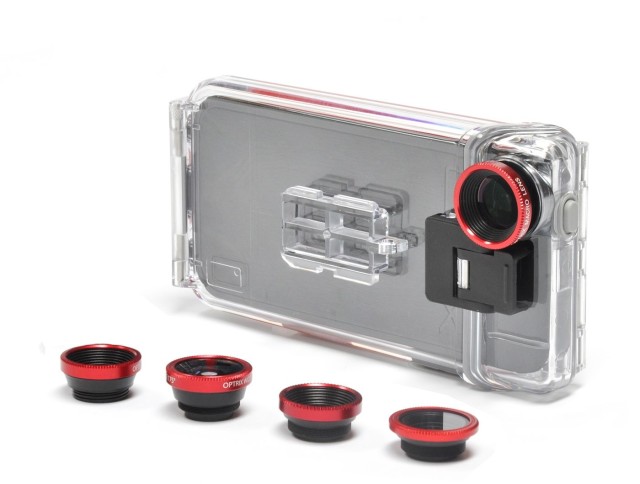
I hope you’re ready for yet another case that adds extra lenses to the iPhone’s amazing camera. This one has a twist. Well, I guess they all do, but this one has a different twist. It’s also ruggedized and waterproof.
I tested a waterproof iPhone case over the summer and it was fantastic, letting me get great images underwater in the pool (what’s the bikini version of “up-skirt” shots?), but also meant I didn’t have to worry about my iPhone when we went canoeing. The problem was the lens. Or specifically the plastic covering the lens, which was a little blurry and spoiled a lot of the shots.
The Optrix, then, would seem ideal. It’s a tough waterproof housing which lets you swap in lenses – a fisheye (useful underwater amirite?), a wideangle and a “flat” lens for straight-through shooting – plus take the iPhone down to33 feet or ten meters under the surface.
It’s also tough (there’s a video on the site of the iPhone meeting a truck, and surviving).
Interested? I’m actually considering it not for the swimming and outdoorsiness, but for its ability to help my iPhone survive the harsh East German winter which I have foolishly decided to subject myself to this year. On a bike.
The Optrix PhotoProX will cost $150, with four lenses (all the above plus a telephoto). Available now.
Data source: via CultofMac (By Charlie Sorrel)
Origine source: Optrix
Get one: Optrix store
The Optrix, then, would seem ideal. It’s a tough waterproof housing which lets you swap in lenses – a fisheye (useful underwater amirite?), a wideangle and a “flat” lens for straight-through shooting – plus take the iPhone down to33 feet or ten meters under the surface.
It’s also tough (there’s a video on the site of the iPhone meeting a truck, and surviving).
Interested? I’m actually considering it not for the swimming and outdoorsiness, but for its ability to help my iPhone survive the harsh East German winter which I have foolishly decided to subject myself to this year. On a bike.
The Optrix PhotoProX will cost $150, with four lenses (all the above plus a telephoto). Available now.
Data source: via CultofMac (By Charlie Sorrel)
Origine source: Optrix
Get one: Optrix store
Monday, May 18, 2015
The Release Date of iPhone 6

iPhone 6 concept.
Apple has reportedly scheduled a big media event for that date, later the iPhone 6 will likely be available in the markets on a corresponding Friday, nearly a week and a half later, possibly September 19.
Apple has scheduled a big media event for Tuesday, Sept. 9 — a date to which Apple numerologists will strain to attribute significance. As with September events past, the focal point of this one is to be Apple’s next-generation iPhones, which are expected to feature larger displays of 4.7 and 5.5 inches and run speedy new A8 processors. Apple declined comment.What distinguishes the iPhones event this year is the official appearance of large-screen iPhones, whether 4.7- inch or 5.5-inch. Despite there are many iPhone users consider that the existing 4-inch screen is the appropriate size, Apple also stated that more than once, but recent surveys claimed that there are willingness from many consumers to get a larger iPhone screen, although its premium price could reach to $100.
In addition to larger screen, 4.7-inch iPhone 6 is expected to feature a thinner, lighter chassis inspired from the fifth generation iPod-touch style along with an A8 processor, 1GB RAM, an upgraded battery (may be with 1,810 mAh capacity, the current is 1,560 mAh), Touch ID fingerprint sensor and an upgraded camera featuring optical image stabilization.
The event may also see the introduction of the 5.5-inch iPhone 6 that could called iPhone Air, while the shipping of it to customers may be later this year or early next year due to production issues. The Re/code report also montioned that Apple is aiming to introduce the iWatch at an October event.
Read also:
- iPhone Air, iPhone 6c concepts that may never be
- Two iPhone 6 Concepts: The First Based on Rumors "Three Different display", the other Featured with Super Thin Version, Solar Charging, and More (Videos)
Sunday, May 17, 2015
New iPhone 6 Concept Edge to Edge 4 6 inch Retina display video

New concept from Gonçalo Madureira and João Madureira shows amazing iPhone 6 with Edge to Edge 4.6 inch Retina display, new design, 12 megapixels iSight camera, recording video in 2K, new touch Home Button with Fingerprint sensor included, and more.
Data source: Youtube [Behance gallery]
Saturday, May 16, 2015
App Icons dont Have to Suck

The days of skeuomorphic icons are gone and in their place are clean, flat icons designs that, in theory, offer an attractive and modern feel. But when the desire for something simple comes at the cost of relevance, icons take a turn for the worse.
Instead of overly elaborate and detailed icons that produced a busy and cluttered feel, the App Store is now overrun with icons that mean absolutely nothing and only serve to harm the appeal of the apps and confuse potential customers.
To help illustrate this, I grabbed a handful of these too-vague-for-their-own-good icons and tossed them into our TUAW team chatroom. I asked what, if anything, each icon tells the user about the app itself -- or, if nothing else, simply what the graphic resembles.
To be clear: This is in no way a commentary on the quality of the apps themselves (and indeed some of these are extremely popular and well-liked) but simply a call for developers to put some more thought into the most public face of their own products.

What is it?
- A charging utility
- An app about Alton Browns bow tie
- A soundboard with nothing but Gomer Pyle saying "Shazam!"
What it actually is: Prompts, an app to help writers find inspiration.

What is it?
- A fingerpainting app, but with only one color choice
- A Smurf penis
- A blue tampon applicator
What it actually is: Vesper, a note-taking and archiving app.

What is it?
- A how-to-make popsicles app (seriously, the fact that its not this is a crime)
- Wild mushroom locator and index
- A ghost with diarrhea
What it actually is: Fancy, a crowd-sourced shopping app with a social twist. And no, it doesnt tell you how to make popsicles.

What is it?
- A digital pregnancy test
- A calculator... obviously
- "The Green Cross" for horrible people who dont like the Red Cross
What it actually is: Gneo, a productivity app.

What is it?
What is it?
- A bacteria guide app
- A camera app that gives everyone in the photo green chickenpox
- A Yoshi ovulation tracking app
What it actually is: thredUP, a clothing marketplace for women, kids and teens.

What is it?
What is it?
- An app that tells you when its near sunset if youre on a cruise ship
- An orange juice review aggregator
- An app that lists all the words that rhyme with orange
What it actually is: Level Money, a budgeting app.
See what I mean?
I get it; Creating a nice icon without an established brand logo to draw from isnt easy, but I promise you it can be done. Here are a few fantastic examples of app icons that are not only clean and attractive, but also offer a hint as to what the app actually does.

What it is: Chefs Feed, a restaurant guide curated by actual chefs.
See what I mean?
I get it; Creating a nice icon without an established brand logo to draw from isnt easy, but I promise you it can be done. Here are a few fantastic examples of app icons that are not only clean and attractive, but also offer a hint as to what the app actually does.
What it is: Chefs Feed, a restaurant guide curated by actual chefs.

What it is: Elixr, a social network and rating service for drink lovers.

What it is: The Converted, an easy-to-use unit conversion tool.
See the difference? Now please, put some more effort into your apps most important symbol before the App Store is filled with icons that are nothing more than simple gradients. Oh god, its happening already.
See the difference? Now please, put some more effort into your apps most important symbol before the App Store is filled with icons that are nothing more than simple gradients. Oh god, its happening already.
Data source: via TUAW (By Mike Wehner)
Thursday, May 14, 2015
Apples iPhone 5s ranks as third most popular Google search of 2013

The iPhone 5s finished behind first-place Nelson Mandela, the South African civil rights revolutionary who passed away earlier this month, and second-place Paul Walker, the Fast and Furious actor who died in a car crash a few weeks ago.
The other smartphone appearing in the top 10 was Samsungs own flagship handset, the Galaxy S4. It came in 8th, just ahead of Sonys PlayStation 3 game console.
The rest of the top 10 subjects, finishing after Apples iPhone 5s, were: Cory Monteith, Harlem Shake, Boston Marathon, Royal Baby, and North Korea.
Apples performance on Googles trending searches in 2013 improved over 2012, when the term "iPad 3" ranked fourth. Last year, the third-generation iPad finished behind Whitney Houston, Gangam Style, and Hurricane Sandy.
The company had three top 10 searches in 2011, when the subjects of Steve Jobs, iPad 2, and iPhone 5 (which would actually become known as the iPhone 4S) were all ranked.
- Read also: Yahoo! Names iPhone Most Searched For Tech Item Of 2013
Data source: via AppleInsider ( By Neil Hughes)Tuesday, May 12, 2015
Microsoft offers free iPhone app for its subscription based Dynamics CRM enterprise service

Microsoft’s Dynamics CRM, a subscription-based customer relationship management tool aimed at small & medium enterprises, is now available on the iPhone via a new app.
The cloud-based service aims to help businesses identify and manage sales opportunities, and track progress from opportunity to sale. The iPhone app provides users with the information needed to prepare for a sales appointment, and allows on-the-spot updating of notes, tasks, contacts, accounts, leads and opportunities.
The service costs £28.70 per user per month.
Compatibility: Requires iOS 6.0 or later. Compatible with iPhone, iPad, and iPod touch.
Free Apps
Category: Business
Released: Oct 22, 2013
Version: 1.0
Size: 1.8 MB
Data source: via 9To5Mac (By Ben Lovejoy)
Category: Business
Released: Oct 22, 2013
Version: 1.0
Size: 1.8 MB
Data source: via 9To5Mac (By Ben Lovejoy)
Monday, May 11, 2015
Apple investigating quantum dot enhanced displays for greater color accuracy


Source: USPTO
Quantum dots (QDs) are technically nanocrystals - in some cases smaller than a virus - made from various semiconductor materials that exhibit special quantum mechanical characteristics. Of interest to display makers, as well as other industries in the optics field, are QDs light-emitting properties. Specifically, the material can be "tuned," or manufactured, to emit very narrow spectrums of light.
According to the filing, the electronic properties of QDs are defined by their size and shape, meaning the colors emitted during excitation can be controlled through fabrication. Nanocrystal size and wavelength emission (more accurately bandgap energy) are inversely related, so the larger the QD, the smaller the emission frequency.
Applied to color, bigger dots will skew toward longer wavelengths like red, while smaller dots emit shorter, higher frequency wavelengths like violet. For example, a cadmium selenide quantum dot may be tuned to gradually reproducing the entire visible spectrum, ranging from approximately 460nm (blue) to 650nm (red). This ability to change color by varying nanocrystal size is unlike current phosphor- or organic-based LEDs, which emit light in a fixed spectrum.
In Apples invention, as with other proposed implementations, a dichroic filter is disposed on a quantum dot-enhanced film (QDEF) in an red/blue/green (RGB) LCD display.

One embodiment calls for a non-QD light source that emits a blue light be combined with a light emitting layer of two QD groups, one red and one green. The layer, possibly a nano-film, is positioned above the first illumination source, thereby absorbing a portion of its blue light to emit red and green light. A second portion of the blue light is allowed to transmit through the QDEF.
The dichroic filter above the QDEF then reflects some of the transmitted blue light back down to be recycled, while allowing an even smaller portion through as white light.
In the embodiment discussed at length in patent applications body, the display also implements an LCD that controls passage of the aforementioned white light through color filters arranged in subpixels. This would provide extremely accurate color reproduction.
A less confusing way to imagine Apples invention would be to follow light emitted by the LED backlight unit. First, a normal blue LED emits light that is sent to a light guide panel. The LGP evenly distributes the light to the back of an LCD panel with color filters arranged in subpixels.
At this point, instead of using phosphors to produce red and green light, the QDEFs quantum dots are brought to photoluminescence by the blue light, which consequently produces red and green light. The dichroic filter then reflects some of the blue light transmitted through the QDEF back to the QDEF, thereby increasing excitation and red/green output.

The filing goes on to explain how brightness can be boosted using prisms and other light forming techniques. Also noted in detail are candidate semiconductor materials from which QDs and QDEFs can be fabricated in a non-toxic manner.
It is unclear if or when Apple will use quantum dot technology in its devices, though the company has a history of delivering some of the best displays in the industry. Recently, however, the colors reproduced by the iPad mini with Retina display were found by one study to be less accurate than competing tablets, possibly leaving some room for improvement.
Apples quantum dot-enhanced display patent application was first filed for in 2012 and credits Chenhua You as its inventor.
According to the filing, the electronic properties of QDs are defined by their size and shape, meaning the colors emitted during excitation can be controlled through fabrication. Nanocrystal size and wavelength emission (more accurately bandgap energy) are inversely related, so the larger the QD, the smaller the emission frequency.
Applied to color, bigger dots will skew toward longer wavelengths like red, while smaller dots emit shorter, higher frequency wavelengths like violet. For example, a cadmium selenide quantum dot may be tuned to gradually reproducing the entire visible spectrum, ranging from approximately 460nm (blue) to 650nm (red). This ability to change color by varying nanocrystal size is unlike current phosphor- or organic-based LEDs, which emit light in a fixed spectrum.
In Apples invention, as with other proposed implementations, a dichroic filter is disposed on a quantum dot-enhanced film (QDEF) in an red/blue/green (RGB) LCD display.
One embodiment calls for a non-QD light source that emits a blue light be combined with a light emitting layer of two QD groups, one red and one green. The layer, possibly a nano-film, is positioned above the first illumination source, thereby absorbing a portion of its blue light to emit red and green light. A second portion of the blue light is allowed to transmit through the QDEF.
The dichroic filter above the QDEF then reflects some of the transmitted blue light back down to be recycled, while allowing an even smaller portion through as white light.
In the embodiment discussed at length in patent applications body, the display also implements an LCD that controls passage of the aforementioned white light through color filters arranged in subpixels. This would provide extremely accurate color reproduction.
A less confusing way to imagine Apples invention would be to follow light emitted by the LED backlight unit. First, a normal blue LED emits light that is sent to a light guide panel. The LGP evenly distributes the light to the back of an LCD panel with color filters arranged in subpixels.
At this point, instead of using phosphors to produce red and green light, the QDEFs quantum dots are brought to photoluminescence by the blue light, which consequently produces red and green light. The dichroic filter then reflects some of the blue light transmitted through the QDEF back to the QDEF, thereby increasing excitation and red/green output.
Color gamuts of QDEF displays compared to sRGB and Adobe RGB.
The filing goes on to explain how brightness can be boosted using prisms and other light forming techniques. Also noted in detail are candidate semiconductor materials from which QDs and QDEFs can be fabricated in a non-toxic manner.
It is unclear if or when Apple will use quantum dot technology in its devices, though the company has a history of delivering some of the best displays in the industry. Recently, however, the colors reproduced by the iPad mini with Retina display were found by one study to be less accurate than competing tablets, possibly leaving some room for improvement.
Apples quantum dot-enhanced display patent application was first filed for in 2012 and credits Chenhua You as its inventor.
Data source: via AppleInsider (By Mikey Campbell)
Image source: TC
Sunday, May 10, 2015
Apple patents accurate touch and hover panel embedded heart rate monitor

Touch and hover
The newer of Tuesdays patents, Apples extensive U.S. Patent No. 8,614,693 for "Touch and hover signal drift compensation" describes a system in which a touchscreen display can accurately determine both hover and touch events.

Source: USPTO
A number of modern computing devices, like Apples iPhone and iPad, incorporate touch-sensitive panels that enhance and define the user experience by affording unprecedented GUI manipulation and control. Some systems also incorporate what is known as "hover" controls, which allow users to interface with a device without actually touching it.
Using specialized internal components, these touch sensitive devices can recognize an object hovering above a display panel, like a users finger or stylus. Once a hover event has been detected, the device may process it as a touch event, handling subsequent actions according to the general rules of traditional touch input. For example, if a hover event occurs over a specific app, that app may be opened.

A general overview of hover sensing technology is provided, including a driver control system in which can generate electrical fields that extend out from the touch panel. When a finger or other object passes through these fields it changes the capacitance of trace lines in the sensor array. By processing the capacitance fluctuations, the system is able to detect a hover event.
As noted in Apples patent, incorporating touch and hover capabilities into one device is a difficult proposition when considering reliability and accuracy. A user may, for example, be holding a phone with their left hand while inputting hover events with the right. If said users left thumb accidentally touches the screen, the device may register it as a touch event.
In one embodiment, touch event compensation can be applied to ignore errant touches. Much like iOS palm rejection technology, touch signal compensation can intelligently determine a users intentions by inferring activity based on signal strength.

For example, as seen above, touch panel may be segmented into quadrants, each of which measures capacitance signals of both touch and hover events. Depending on the location and saturation of a signal, as well as duration and other metrics, the system can classify an action as a legitimate touch or hover event. Managing the system is a set of rules based on predefined thresholds.
In other embodiments, object shape and profiling may be implemented to parse out hover events. For example, a user may point at a UI asset such as an app icon, which results in a certain shape profile as "seen" by the touch screens sensors. Size and distance from a sensor panel may also be used to determine whether a user intended to invoke a hover event. Also provided for are solutions for concurrent touch/hover events and multi-hover events as measured and processed by capacitance and threshold rules.

Apples patent particularly focuses on compensation for signal drift in a touch sensor panel. Touch sensing devices measure changes from a baseline capacitance — that is when no object is touching or hovering over the device — generated by touching or hovering over the array. Environmental factors like ambient temperature, humidity and pressure play a large role in how well the system operates. Operating changes, such as component shifts, expansion or contraction, could also impact baseline.
When these changes to the baseline capacitance substantially affect measurements indicative of a touch or hover event, it is known as signal drift.

To combat signal drift, Apple proposes a compensation method that resets the baseline capacitance of a touch sensor at periodic intervals, thereby accounting for environmental, operating, mechanical and other changes. When a new baseline is defined, the system can apply the change to capacitance measurement thresholds to correct for signal drift.
In one embodiment, a grounded plate can cover the touch panel when not in use, such as a protective device cover. With the plate temporarily covering the panel, and no touch or hover events being logged, a baseline reading can be taken and a subsequent signal drift compensation applied.

When the plate is not covering the screen, recalibration is suspended because it is more likely that the user will be touching or interacting with the device during this time. Alternatively, the sensor panel can recalibrate when the device is attached to a grounded dock.
In another embodiment, the device can take readings dynamically in between touch and hover events. By using on-board sensors, the recalibration system can intelligently select the most opportune time in which to reset the baseline. For example, recalibration might be suspended if the device is thought to be in motion, or if touch and hover events are being logged. When the unit is stationary and no touch or hover event is recognized, the system may set for baseline signal drift.
The patent continues with an in-depth look at other touch/hover panel implementations, including touch and however switching, signal resistance calibration and sensitivity variation compensation, among others. Also covered are various input techniques, including cameras and on-board motion sensors, and their integration into a display.

It is unknown if Apple will one day choose to incorporate hover controls into its products, but some companies are already working on their own solutions. Rival Samsung, for example, recently rolled out hover-based Air View and Air Gestures features with its Galaxy S4 handset.
Apples touch and hover sensor panel patent was first filed for in 2010 and credits Brian Michael King, Omar Leung, Paul G. Puskarich, Jeffrey Traer Bernstein, Andrea Mucignat, Avi E. Cieplinski, Muhammad U. Choudry, Praveen R. Subramani, Marc J. Piche, David T. Amm and Duncan Robert Kerr as its inventors.
Heart rate monitor
As for the heart rate monitor, Apples U.S. Patent No. 8,615,290 for a "Seamlessly embedded heart rate monitor" remains largely unchanged from AppleInsiders initial report on the propertys application in 2010. The patent employs sensors to read a users EKG data, which can then be used to authenticate said user or indicate their mood.

Basically, Apples invention measures cardiac signals read by sensors embedded into metallic conductive portions of a device housing. The sensor leads can be successfully hidden or embedded, into the chassis housing, possibly in the screen bezel. These leads pick up minute electrical signals unique to a specific users heart, which can be measured to a degree of accuracy high enough as to provide an adequate means of identification.
The latest Apple patent is evidence that the company is actively investigating deployable biometric security solutions that rely on users bodies rather than stored or memorized codes, one such system being the Touch ID fingerprint reader.
Apple credits Gloria Lin, Taido Nakajima, Pareet Rahul, and Andrew Hodge as the patents inventors. The property was originally filed for in 2009.
Data source: via AppleInsider (By Mikey Campbell)
Image source: TC
Saturday, May 9, 2015
Pebble Smart Watch Update With Support for iOS 7 Notifications Now Live

Following last weeks announcement of a significant update that would bring iOS 7s Notification Center alerts to the Pebble Smart Watch, Apple has approved Pebbles app update, enabling the new functionality for Pebble owners.
Version 1.3.0 of the Pebble Smartwatch app supports Apples iOS 7 notification system for the iPhone 4s and higher, allowing all Notification Center alerts to be displayed on the watch face. Previously, notification alerts were limited to calls and text messages, but now the Pebble Smart Watch is able to display notifications from apps like Twitter, Facebook, Google+, Calendar, Instagram, and more.
Along with the new notification functionality, Pebble has also launched its 2.0 SDK, adding APIs for Javascript, Accelerometer, Data Logging, and Persistent Storage to allow developers to create apps that interface directly with the web.
The Pebble Smart Watch can be purchased from the Pebble website for $150. Pebble Smartwatch can be downloaded from the App Store for free.
Version 1.3.0 of the Pebble Smartwatch app supports Apples iOS 7 notification system for the iPhone 4s and higher, allowing all Notification Center alerts to be displayed on the watch face. Previously, notification alerts were limited to calls and text messages, but now the Pebble Smart Watch is able to display notifications from apps like Twitter, Facebook, Google+, Calendar, Instagram, and more.
Along with the new notification functionality, Pebble has also launched its 2.0 SDK, adding APIs for Javascript, Accelerometer, Data Logging, and Persistent Storage to allow developers to create apps that interface directly with the web.
The Pebble Smart Watch can be purchased from the Pebble website for $150. Pebble Smartwatch can be downloaded from the App Store for free.
To review and download Pebble Smartwatch on the App Store click here.
Compatibility: Requires iOS 7.0 or later. Compatible with iPhone, iPad, and iPod touch.
Free Apps
Category: Lifestyle
Updated: Nov 11, 2013
Version: 1.3.0
Size: 11.4 MB
Data source: via MacRumors (By Juli Clover)
Free Apps
Category: Lifestyle
Updated: Nov 11, 2013
Version: 1.3.0
Size: 11.4 MB
Data source: via MacRumors (By Juli Clover)
Friday, May 8, 2015
Space Gray iPhone 5s Most Popular Amid Supply Constraints Blue Leads for iPhone 5c

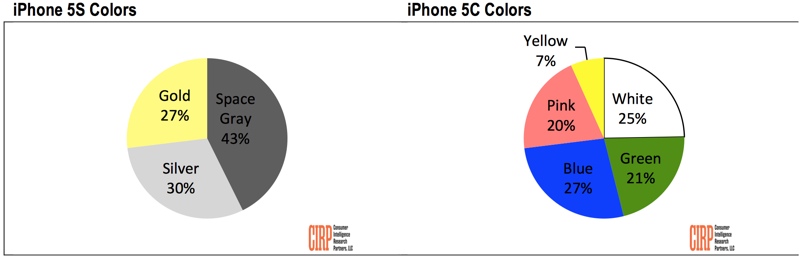
According to new color preference data from Consumer Intelligence Research Partners (CIRP), Apples space gray iPhone 5s was the most popular choice for consumers in the United States, followed by the silver and gold models, which is unsurprising given significant supply constraints of the gold and silver iPhones.
43 percent of iPhone 5s units sold were space gray, while 30 percent were silver and 27 percent were gold. Supplies of the space gray model were more readily available than the silver and gold iPhones, but consumers have demonstrated a preference for the black iPhone in the past.
For the iPhone 5c, blue proved to be the most popular choice with 27 percent of purchasers choosing the color, followed closely by white at 25 percent, green at 21 percent, and pink at 20 percent. Apples yellow iPhone 5c was the least popular color, purchased by only 7 percent of the 400 consumers surveyed in the month after the phones launched.
Broken down by gender, women had a preference for the silver iPhone 5s, while men preferred space gray. Gold was equally split between both genders. Men also had a preference for the white and blue models of the iPhone 5c, while the pink iPhone 5c fared much better with women.
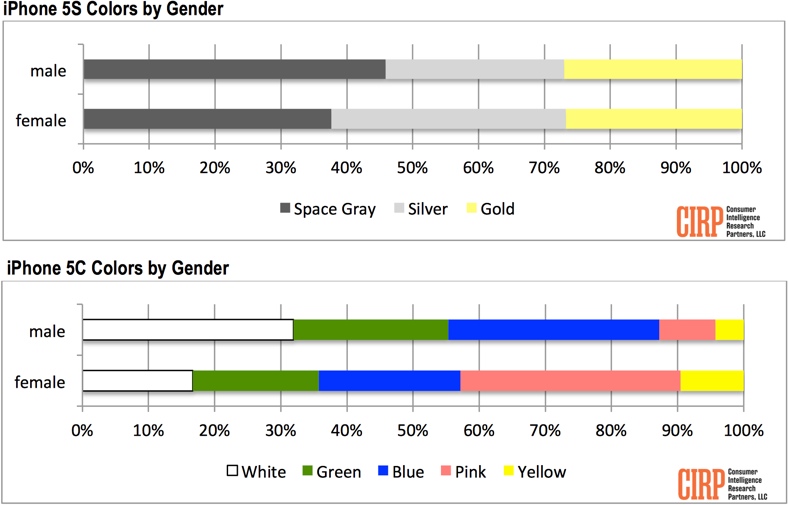
Said CIRP Partner and Co-Founder Mike Levin, "iPhone 5S and 5C colors seem to confirm some traditional gender biases. In the iPhone 5C, men prefer the neutral white, and the Space Gray in the iPhone 5S. In contrast, women prefer lighter silver 5S and the brighter iPhone 5C colors. Interestingly, no one, including the women in the survey, appears to want the Yellow iPhone 5C very much."
Because multiple models of the iPhone 5s have been difficult to obtain, CIRPs data gives an incomplete picture of iPhone 5s preferences. It is possible that consumers desiring a gold iPhone chose another color when supplies ran out or have yet to make a purchase. Data on the iPhone 5c is likely more accurate, as supplies of the phone have been plentiful since launch.
Data source: via MacRumors (By Juli Clover)
Thursday, May 7, 2015
Developers Can Now Delete Fake Scores from Game Center Leaderboards

As noted by our sister site TouchArcade, Apple announced that game developers now have the ability to view and edit the top 100 positions in Game Center leaderboard listings for their games, giving them the power to delete fake scores from the list.
You can now view and manage the top 100 scores and usernames for all of your Game Center leaderboards. Protect your legitimate players by signing in to iTunes Connect to delete fake scores or block players that post fake scores. You can also restore scores and players within the same time period.
A number of high-profile games have seen fake Game Center scores clogging up the very top of their global leaderboards, and Apples new feature should go a long way to assist developers with cleaning up their leaderboards. The feature will also give legitimate users shooting for the top of the lists more recognition for their efforts, should developers of their games choose to take an active role in monitoring for fake scores.
Apple notes in its developer documentation that developers can view the top 100 scores for various leaderboards, delete and restore scores from the lists, block players from posting scores to a leaderboard, and restore blocked players with their most recent scores prior to being blocked.
One issue with the new feature is that scores are maintained for review for only 30 days, meaning that scores need to have been added within that window in order to be available for removal. Likewise, removed scores and blocked users can only be restored within that same window.
It is currently unclear if Apple has any plans for or is open to the possibility of offering developers a one-time sweep to help clear out fake scores that have accumulated since the launch of Game Center three years ago, but at the very least developers can clean up any new fake scores being posted to their leaderboards if they remain vigilant.
Apple notes in its developer documentation that developers can view the top 100 scores for various leaderboards, delete and restore scores from the lists, block players from posting scores to a leaderboard, and restore blocked players with their most recent scores prior to being blocked.
One issue with the new feature is that scores are maintained for review for only 30 days, meaning that scores need to have been added within that window in order to be available for removal. Likewise, removed scores and blocked users can only be restored within that same window.
It is currently unclear if Apple has any plans for or is open to the possibility of offering developers a one-time sweep to help clear out fake scores that have accumulated since the launch of Game Center three years ago, but at the very least developers can clean up any new fake scores being posted to their leaderboards if they remain vigilant.
Data source: via MacRumors (By Eric Slivka)
U S Regional Carriers and Canada Announcing October 1 Launch Date for iPhone 5s and iPhone 5c
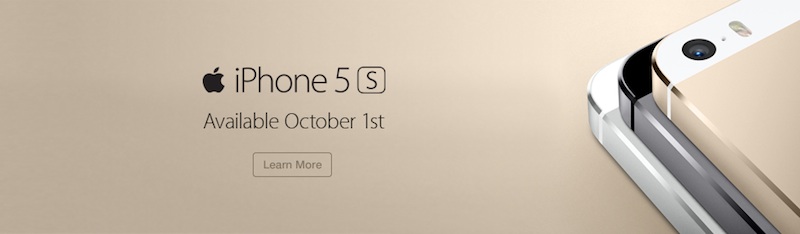
Carriers involved in the October 1 launch include:
- Appalachian Wireless
- Bluegrass Cellular
- C Spire
- Cellcom
- GCI
- MTA
- Nex-Tech Wireless
- Ntelos
- Strata
Several other regional carriers have announced that the iPhone 5s and iPhone 5c are "coming soon" and some of those carriers may also be participating in the October 1 rollout, but they have not announced their exact launch dates yet.
Apple has gradually expanded availability of the iPhone on regional carriers throughout the United States in recent years, with over 25 U.S. carriers now offering the device.
Update: Canadian regional carriers also appear to be participating in the October 1 launch, with MTS announcing its launch a short time ago. SaskTel lists the new iPhones as "coming soon", but representatives have so far only said on Twitter and Facebook that the carrier is still working out launch details.
Update 2: SaskTel has now officially announced that it too will begin selling the iPhone 5s and iPhone 5c on October 1.
Update 3: Alaska Communications has also announced that it will begin selling the iPhone 5s and iPhone 5c beginning on October 1.
Data source: via MacRumors (By Eric Slivka)
Subscribe to:
Comments (Atom)